Landscapes Of Power: Inside Sanam Khatibi's World
Art — 09.03.26
Words: Joana Valente
Coming across Sanam Khatibi’s paintings at BRAFA Art Fair felt unexpectedly pleasing and immediately unsettling. There is a certain quiet brutality in her figures and, by contrast, a serenity in her landscapes, as if nature is quietly observing what is happening in each scene.
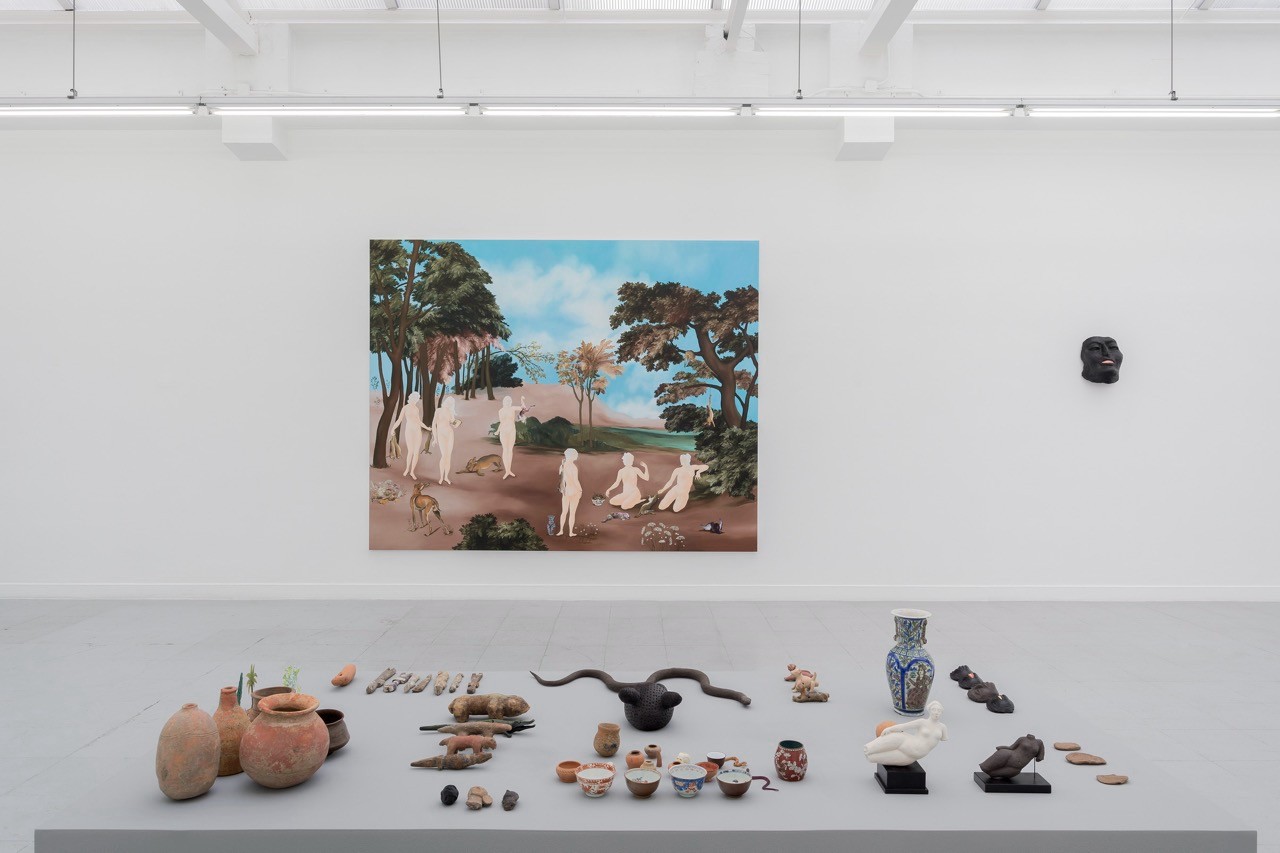
Rivers’s In Your Mouth, Rodolphe Janssen, 2017. Courtesy of Sanam Khatibi.
The Belgian artist, of Iranian heritage, began exhibiting in 2014. Her paintings bring desire and domination; bodies that appear exposed yet powerful, nature that is lush but never innocent. Animals, objects, and fragments of life appear like clues, not symbols with a fixed meaning, but traces. At the center of her practice is a question that lingers beneath the surface of every scene: what happens when an artist paints otherworldly spaces and creatures, and how much of the “self” does it require?
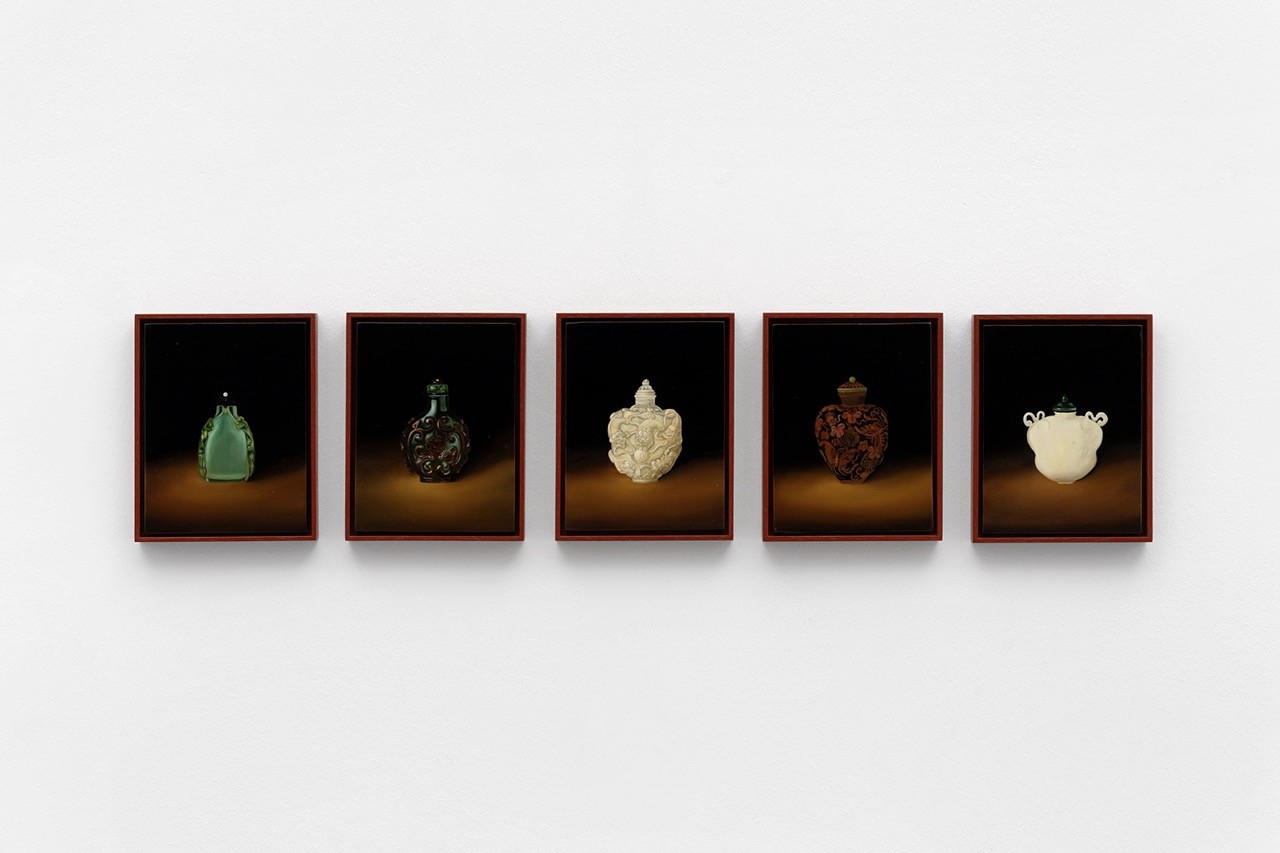
Amulets, 2024. Oil on panel framed 14.7 x 11. 6 cm. Courtesy of Sanam Khatibi.
Her studio routine is disciplined, almost ordinary: coffee at 9:30, work by 10, administrative emails dealt with quickly “so [she] can concentrate on painting without thinking about administration.” But the work itself demands a mental state closer to disappearance than control. “If I think, then it does not happen. In a way, I am not there when I am painting.” It is precisely in this absence that the painter seems to enter the worlds she creates.
Her scenes emerge from instinct rather than explanation, and that impulse is not new. “My childhood was chaotic and traumatic on many different levels,” Khatibi explains. “I learned very quickly to escape in my imagination…so in a way I lived in parallel worlds.” The paintings read less as fantasy than as psychological space, charged with memory, fear, and appetite. In the artist’s world, desire is never soft, behaving like a force of nature: bodies appear exposed but not necessarily vulnerable; animals drift through the compositions like witnesses or accomplices. Even when the palette is exuberant, the atmosphere carries tension, as if something has already happened or is about to. The scene refuses to resolve into one true narrative.
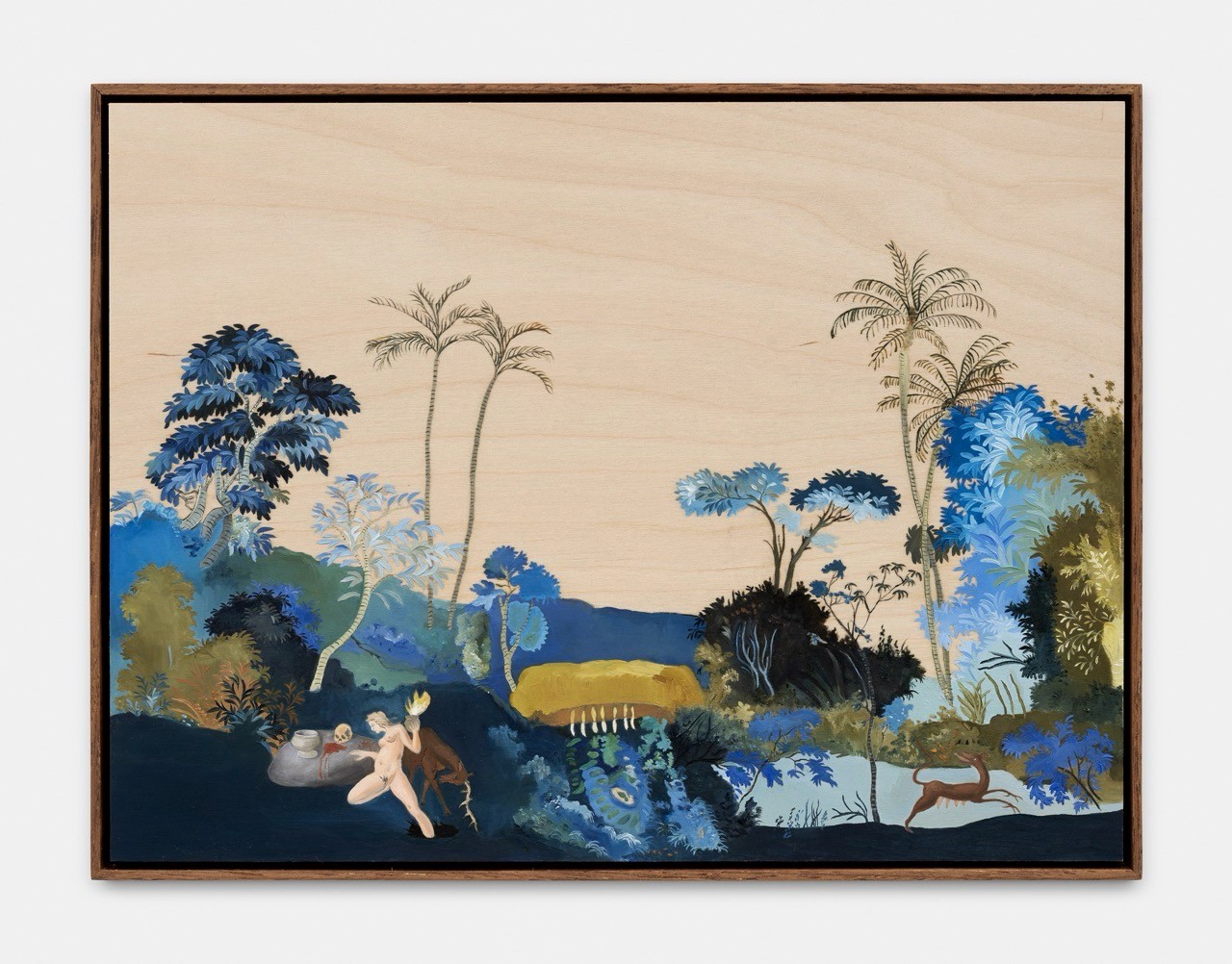
Sonnets of Orpheus, 2021. Oil, pastel and pencil on panel framed 24 x 31 cm. Courtesy of Sanam Khatibi.
Objects have also shaped her visual language, particularly through her relationship with her mother, who was a collector. Khatibi references these objects in paintings and still lifes, treating them not as decoration but as emotional markers. In Rivers in Your Mouth, a show presented in Brussels in 2017, she brought her own objects into the exhibition space, arranging them on a table and magnifying their presence both in her creative process and her life.
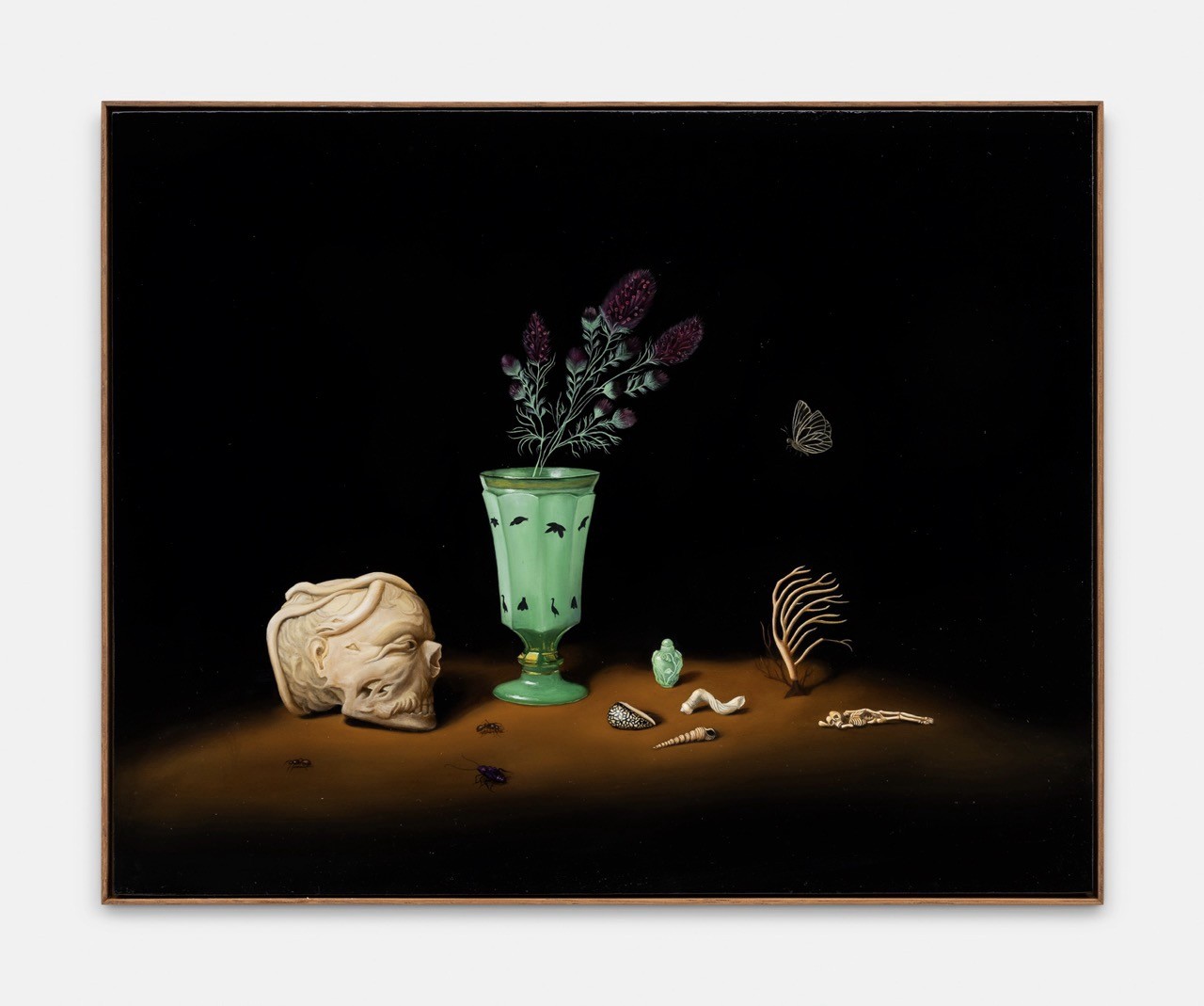
Anthem, 2022. Oil on panel framed 41 x 56 cm. Courtesy of Sanam Khatibi.
Yet, although objects remain part of her vocabulary, Khatibi’s first decision when beginning a painting is rarely a figure or an item, but the setting around them. “The starting point for me is always the landscape—the wilderness,” she says. This landscape becomes the engine of her work: the space where human behavior turns animalistic.
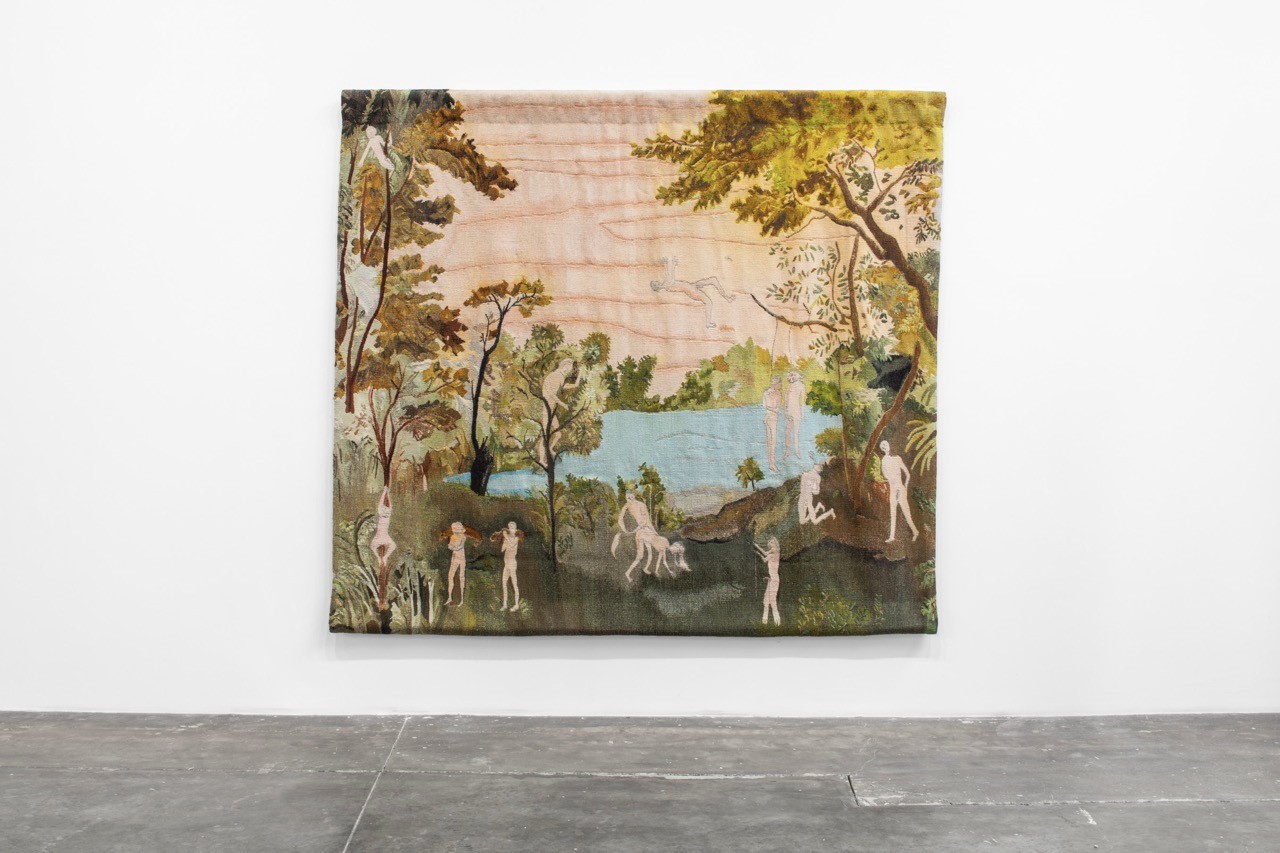
Nothing Has Ever Worked For Me, 2022. Handwoven wool tapestry 220 x 260 cm. Courtesy of Sanam Khatibi.
This tension—between beauty and threat, calmness and brutality—also explains why her paintings often feel charged by the world outside of them. During her second solo show at Rodolphe Janssen, she titled the series The Murders of the Green River, referencing the title of a podcast episode she listened to while working in her studio. The episode discussed the case of Gary Ridgway. “It instantly brought a new viewpoint to the paintings, which was intriguing, so this is how the series was named…I never painted the scenes thinking of a serial killer or the actual events,” she says. The title became a door: not a direct reference, but a second layer of meaning.
Still, even if the title remained only a title, it carried a weight she did not anticipate. It caught the attention of the brother of one of Ridgway’s victims, an unexpected message that, she says, deeply moved her. The emotional impact of her paintings had crossed into reality.
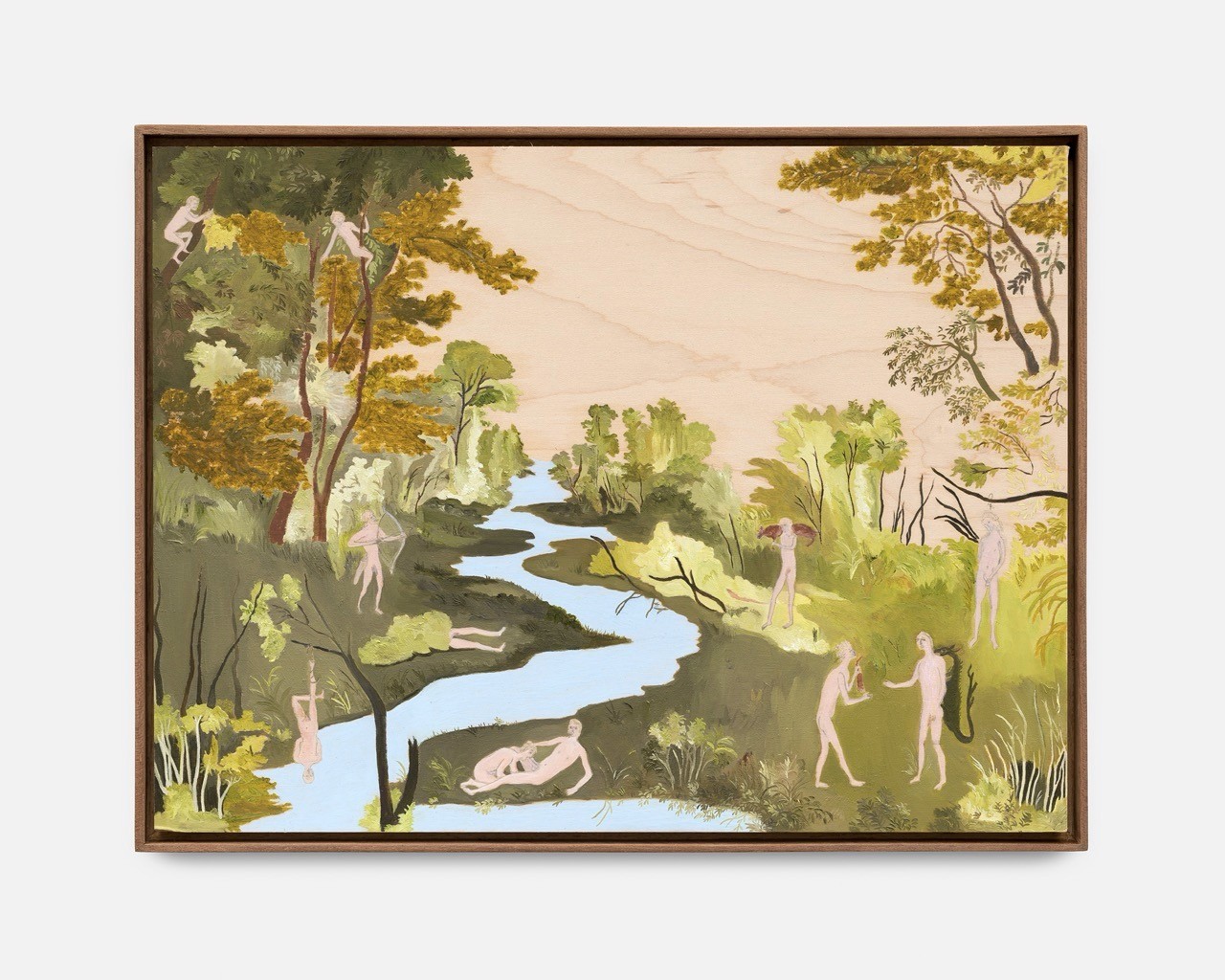
On Wilder Shores, 2018. Oil, pastel and pencil framed 24 x 31 cm. Courtesy of Sanam Khatibi.
“Nothing we do is either black or white. It’s this grey area I’m interested in,” Khatibi says in a mini documentary for Mendes Wood DM in Paris. It summarizes the foundation of her work with precision. Humans love things as much as they break them, and that contradiction, the pull between tenderness and destruction, is what gives her paintings their discomfort. The tenderness lives in the wilderness, while destruction unfolds in the actions of her characters.
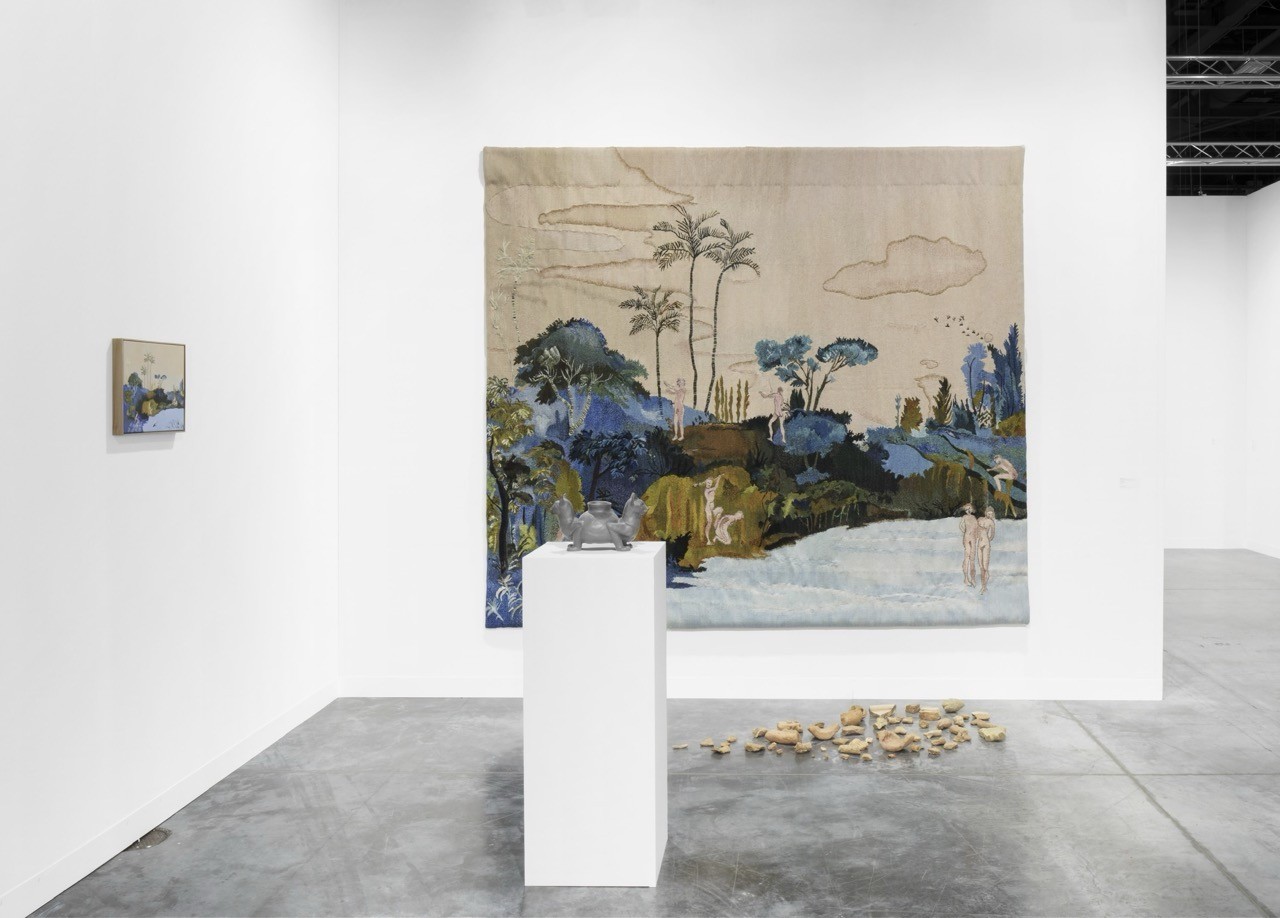
I Dreamed I Stabbed You in the Eye, 2019. Installation Istanbul Biennial, Installation View. Courtesy of Sanam Khatibi.
Up next for the artist is Magical Landscapes, a group exhibition at Kunsthal KAdE in Amersfoort, Netherlands, opening in June 2026. In Spring 2027, she will present a solo exhibition at MACS, Le Grand-Hornu in Boussu, Belgium.