Beauty Was Never Innocent: Two Exhibitions in Tension at Bozar Brussels
Art — 12.06.26
The human body has long been one of the central subjects in art history, from the Renaissance to contemporary practice. Currently at Bozar, the Center for Fine Arts in Brussels, two exhibitions—Bellezza e Bruttezza (through June 14) and Picture Perfect (through August 16)—reveal that beauty ideals have never been neutral.

“Be Nice To Me” Video installation, 2026. Courtesy of Pipilotti Rist, Hauser & Wirth and Luhring Augustine
To understand how these two exhibitions connect, it helps to start with the past; that’s why stepping into the centuries-old Bellezza e Bruttezza exhibition first was a choice made intentionally. The dark blue walls and low lighting create a contained, almost theatrical atmosphere, one that immediately slows you down. In sharp contrast to Picture Perfect, where the work is more urgent and direct, the pace here is quieter, which makes the historical material feel even more charged. A page from one of Leonardo da Vinci’s Vitruvian Man books presents the exact measurements for what was considered an ideal female body, centered solely on anatomy and the language of health. Looking at it through a 21st-century lens, it is striking because it exposes an idea of perfection as less human.
Nearby are the sculpture and paintings of The Fountain of the Three Graces, most commonly attributed to Guglielmo della Porta, which symbolize beauty, harmony, and fertility. These works faithfully reproduce those ideals while also showing how deeply they shaped Renaissance notions of femininity. Walking through this gallery of faces—mostly fair-skinned, with long blonde hair, fine eyebrows, medium breasts, and rounded bellies—makes you question how much of that version of beauty is manufactured. In many cases, women used harsh chemicals to meet those standards, or even paid artists to make them appear that way. Today, the tools have changed, but the underlying logic is familiar.

Courtesy of Bozar Brussels
On the other side of the coin, the next section of the exhibition presents the “ugly” or “monstrous.” What counted as beautiful, and what counted as grotesque, was never fixed. It depended on the painter, but also on the person commissioning the work. That distinction matters because it exposes how much of visual culture has always been shaped by money and status.
One of the most memorable works in this exhibition is The Portrait of Madeleine Gonzales, daughter of Pedro Gonzales from Tenerife, Spain, part of the so-called “hairy family” in the late 16th century due to hypertrichosis, a condition that causes excessive hair growth. Displayed in the center of the room, standing alone, isolated, it automatically invites viewers to reflect on the loneliness these children may have felt in a period when medicine offered little explanation and even less compassion. They were considered a “natural wonder,” but the portrait still grants them dignity: dressed in a child’s gown, with a jeweled cross on her chest and a crown on her head, she appears protected by status even while marked as unusual. In those times it was easier to portray marginalized people as a target for mockery, but when money was involved, the image of someone with blue blood could not be damaged, no matter how different they looked.

Pedro Gonzales. The Portrait of Madeleine Gonzales. Oil on canvas. c. 1580. Courtesy of Bozar Brussels.
The manipulation of physical appearance continues in Picture Perfect, where the interactive setup collapses the distance between viewer and artwork. Sounds echo through the rooms, benches invite visitors to sit, and screens play videos that demand attention.
The first works you encounter are about women’s hair across different parts of the world. In one corner are six photographs of Nigerian women’s hairstyles by J.D. ’Okhai Ojeikere, interspersed with images of women with extremely long hair. Together, they make it clear that attractiveness is reflected very differently across cultures. That tension continues in Protomaton by François Bellabas, a machine linked to an AI prompt. Depending on which button you press, your face is distorted, then printed out like a photobooth image.

J.D. ‘Okhai Oijekere. Adebe. 1975. Courtesy of Galerie MAGNIN-A, Paris
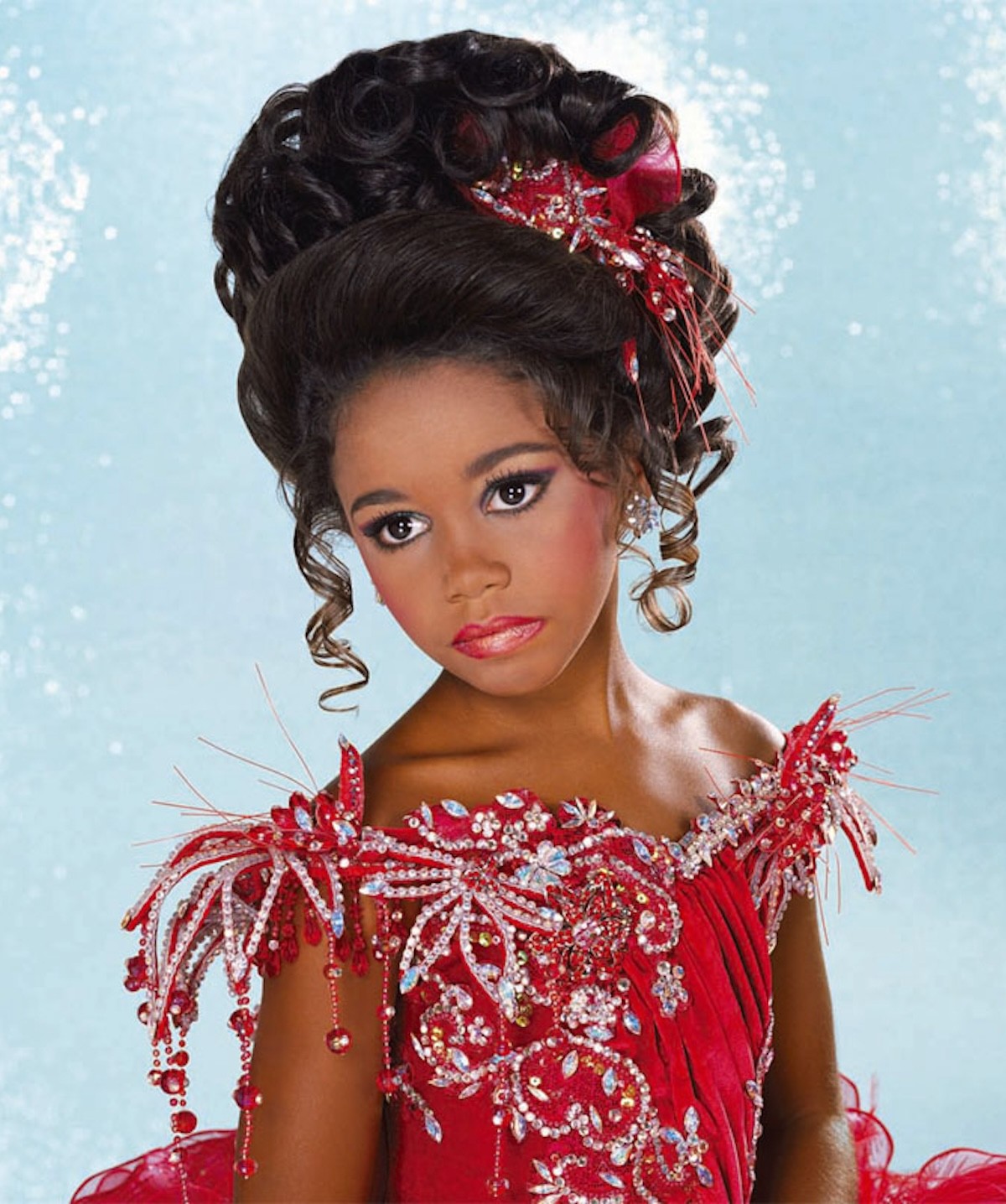
High Glitz by Susan Anderson shows young girls in the United States being styled to look like adults. The series exposes the world of child beauty pageants, where performance and grooming are folded into spectacle—not unlike the Renaissance, when children were dressed as miniature adults to look formal and beautiful. The difference now is scale. In the Renaissance, only the wealthy could afford such alterations. Today, globalization, medicine, beauty products, and digital tools, have changed that.
-

- Susan Anderson. High Glitz. 2009.
And although women continue to carry the heaviest weight of beauty pressure, Bryce Galloway’s video broadens the exhibition’s scope to male insecurity and vulnerability. In it, he silently glues his chest hair to his scalp, performing his own male pattern baldness as something that needs to be fixed. By the time the exhibition reaches Martha Rosler’s Body Beautiful, or Beauty Knows No Pain, the argument here is unmistakable. Naked bodies collaged from men’s magazines and glossy print ads do not read as liberation; they read as evidence of a system built on repetition, objectification, and appetite.
The last piece shifts the exhibition into more urgent territory. Eli Cortiñas’s video, with its AI female character speaking about women’s rights, closes the exhibition with a contemporary force. “A war on women is declared,” she says. “Forced sterilization, abortion bans, the state is moved into our wombs—new forms of violence, new forms of resistance.” It is a powerful, full-circle closing note: the body is still a site of control, but also of resistance.
The standards may have changed, but the struggle over who gets to define beauty, and who gets to exist within it, remains.